I wanted to share with you a few fashion nuggets from my wardrobe that I stumbled across while giving it a tidy-up. They happened to merge into quite a nice blog post.
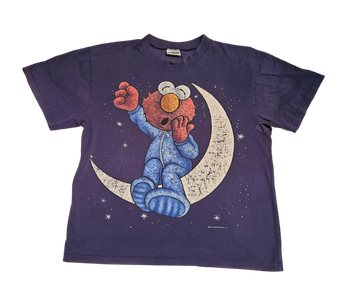
My friends in high school gave me a t-shirt one year for my birthday. It features baby Elmo, fast asleep on a big crescent, glow-in-the-dark moon. I know they chose it, with love, because they thought it represented me. I was often half-asleep, in a daydream, or not really aware of my surroundings. Not to mention, I was — and still am — a famously horrendous snorer, even back in high school.
Well, that was about 27 years ago now. This shirt has seen a lot in that time and always reminded me of those friends from school. Today I noticed that the holes in the armpits were no longer the only holes in it — they were popping out all over as the print on the front flaked off. I had to finally admit that it was ready for recycling, disintegrating before my eyes (and everyone else's!).
That's the mark of a quality shirt: 27 years of wear, and though the last 15 were probably only to bed, that's pretty damn good. It helped that it was made in Australia by Top Heavy, from proper heavy cotton — my friends didn't cheap out on me.
I added my t-shirt to my textile recyclables pile going out. Along with...
...my last pair of soft black 3/4 leggings. These leggings were all the rage when my oldest son was small. You could get them at the Warehouse for about $15. They were buttery soft and so light. You could wear them with a long t-shirt or a short dress, even under short shorts for a more modest effect. I wore mine a lot, even to bed because of how soft and comfortable they were. For a while.
The leggings had a remarkably short lifespan. They were made with a fair bit of elastane, and not a lot of anything else. Once they'd been through the wash more than a couple of times, they became thinner and thinner. More transparent, baggy, and then before very long, holey. But they were so good to begin with that I'd go right out and buy another pair. And another. I'd be cycling through them regularly: a good pair within their first 10 wash cycles, another more worn pair for around the house, and last-legs pairs for painting and messy jobs. I sure did get through a few.
My last pair have been in a sorry state for a long time, but I couldn't part with them because the Warehouse had discontinued them and I couldn't get any more. Probably just as well.
What the Warehouse do offer these days is the "Good Drop" box. This pilot programme sounds too good to be true. The idea is that you bring your worn-out clothing to the Warehouse and drop it in the box to be recycled. In "return" you get a voucher for 10% off new clothing at the Warehouse.
I'm not saying this isn't a good initiative, or that it isn't a good deal for Warehouse customers. It is. It's even a good deal for anyone (if there is anyone) who isn't a Warehouse customer, because you don't have to collect that voucher, or use it — you can just drop and go. So good. What could possibly be wrong with this?
Did you feel it just then? That naughtiness of just dropping your old clothes and leaving the store? That was it — the tell. It's how you know what that recycling box really is. It's not just a recycling scheme; it's a loyalty programme. And you weren't loyal. To the Warehouse. You didn't buy more clothes. Well, you aren't obligated to, so why should you feel bad? Because that's the marketing trick: they're doing you a good turn, so you should do them one back and buy some clothes. It encourages people to buy clothing at their stores, at the same time as it incentivises them to offer clothing that doesn't last well — and gives them no reason to offer the quality clothing that would go the distance.
And there's a second thread to untangle here: the way that box frames its offer. Like a donation. Like your old clothes are a gift, no matter their condition. Some textile recycling boxes around the country even say "place your donation here." But that's really just guilt amelioration for your benefit, so you can let go of the tension of a wardrobe clean-out and getting rid of a whole lot of things you could still have continued to use. And… replacing them with new ones! That's why they're in malls. And in the Warehouse. What's really happening is that it costs money to recycle old clothing, so the stores absorb that cost and make you feel good about wasting what you already have — to get you through their door, with your wallet, for their benefit. It feeds the wishcycling instinct, the hope that "someone, somewhere can use this" — when really, the only person who was ever going to keep wearing your clothes, honestly earned stains and all, is you.
And the third thread to untangle is that box system loses track of where most of the clothing actually ends up. It's lovely to say it goes to the Salvation Army next — the Warehouse's own website says just over half of it (52.4%) goes to the Salvation Army to rehome, with most of the rest recycled. But what happens to it if the Salvation Army can't sell what they take? Does it get re-routed to recycling then? I suspect not. The Good Drop's accounting stops as soon as it gets to the Salvation Army's door. It just gets counted as redistributed — a green tick — and if it doesn't sell, then where? Silent.
If you've volunteered in an op shop, you'll know how much doesn't get sold, and how quick the take-off turnaround is. And you'll know where it goes after the shop floor: other than a small number of op shops putting real effort, and money, into this, it's the rubbish bin.
That brings me to my last clothing nugget. This one wasn't in my wardrobe, but it rounds out the narrative nicely. It's already in my recyclables pile, because it came to me by way of an op shop recycling bag: a very stylish, pretty jacket in a classic Jackie-O cut, from Farmers. Woven boucle yarn with lurex running through it, a nice zip, "vegan leather" trim, and a cardboard swing tag in perfect condition. I can't pretend to know its story, but to me it reads like this — someone bought it, never found the occasion to wear it, the "vegan leather" (made from petrochemicals) perished, and the item got "donated" to charity. The charity couldn't sell it, because it wasn't in giftable condition. It needed repair, and who was going to do that? No one — because it found its way to me, to be recycled, with its tag still attached.
No one ever got to wear this jacket. And yet it cost people to pass it around, and it has cost me to pick it up, evaluate it, decommission it, make sure it's clean and fresh, and then bale it to go to my recycler on a truck burning fossil fuels — but only once the trim is removed, because "vegan leather", PVC, vinyl and plasticised fabrics can't be recycled. But — the manufacturer and the retailer still got paid. There is absolutely no incentive there for them to stop making products like this, that perish before they can even be worn. How can the individual consumer ever win out against bad design and a slick marketing machine?
We will always need to do some textile recycling if we want to keep wearing clothes. But, recycling is not the complete answer. Any recycler worth their salt will tell you that. It's the last stop in the line for your truly worn-out things. Not everything can be recycled — the technology just isn't there for all the garments this broken system produces. The regulation isn't there to stop the broken system producing them. And of all the money our government spends on other recycling streams and schemes, barely a cent of it goes to textiles.
None of this makes those boxes the enemy. They have a place. The trick is to see them for what they are and use them with purpose. End-of-life clothing goes in the recycling box. Anything still good enough to be a gift to a friend should be taken directly to your favourite charity that will genuinely pass it on — not the other way around. And if you're brave enough, ask that charity what will happen to it if it cannot be sold.
So where does that leave us? Mostly, further up the waste hierarchy than any box:
- Buy only what you will use and love, and buy quality.
- Use it completely whenever possible. That "someone, somewhere" who wants your mostly worn-out clothes is a phantom, and even phantoms deserve actually good clothing.
- Be discerning when voting with your wallet. Right now the people making and selling to us will make whatever they can sell, not what will last or can be recycled.
- Ask more of our government on this issue. They're the ones who have real power to shift the needle meaningfully.
When it does eventually come to recycling, we can offer kaitiakitanga for that final stage — getting your textiles to a place where each piece has the best shot for its next life and starting its next chapter. But that's a story for another time.